Categories
Uncategorized

The Electronics Debate

There is a time and a place for electronics in your Child’s life

What age do I give my son or daughter their own electronic device? Good question. I feel it depends on what your child is going to use it for. If it is for pure entertainment I would say not till they are 14 or 15. If it has a function to play in their ability to get through the day easier then, that is another story.

There are so many learning apps you can download.  I have mixed emotions about using an Ipad or tablet as a teaching tool. In my opinion, children these days get more than enough screen-time and I feel anything you can teach on an Ipad you can teach with a pencil and paper or any of the other tools teachers used well before computers. There is always the case of attention and motivation though. Sometimes the picture or voice at the end of a problem on the computer is motivating and the child is more engaged than with other non – electronic tools.

Some of the apps I do use regularly with some of my clients include:

The handwriting without tears app teaches proper letter formation.

Injini: Child development app has play based games that teach such things as shapes and colors, writing skills, auditory and visual discrimination, patterns and cognitive and fine motor skills.

There are several apps I use for desensitization programs for life skills like:

Hair cutting

Dentist

There are several different dentist apps that I like.

https://itunes.apple.com/ca/app/tiny-dentist/id561690275?mt=8

https://itunes.apple.com/us/app/brush-teeth-toothbrush-timer-dental-brushing/id1052694241?mt=8

https://itunes.apple.com/us/app/brush-up-the-toothbrush-training-game/id967009000?mt=8

Doctor /hospital

Here are two but there are so many Dr./Hospital apps I have used with kids.

https://itunes.apple.com/us/app/kids-doctor-dr-office-salon-kid-hospital-games/id709617197?mt=8

https://itunes.apple.com/us/app/doctor-kids-hospital-game-for-children/id876312848?mt=8

There are also some really helpful apps for life skills.

Google calendar has so many options that help children on the Autism spectrum, with high anxiety, and or with an executive functioning disorder.  The calendar allows the child at any point to know what to expect that day or that week at a glance. I use reminders for children who have trouble with the sound of the fire bell, or the chaos that happens when it goes off. It gives them a heads up and a minute or two to prepare themselves. For example get their ear protection on, or just know it is coming so it will not catch them off guard.  Also, like Google calendar, because you can color code it so the child knows their schedule and that of the families. It’s great for when the child’s schedule changes from their normal schedule. I also like how it adds pictures to the background of an event to give the child a visual cue of what is to come.

Many children also use I pads as their communication device. The beauty of this is that many of the ACC apps have locking mechanisms so your child can only use it as their communication device and not as a U tube device.

There are also several meditation apps available. Insight timer is favorite one that I use when the children I work with need some down time or before bed for my respite kids. It has a wide range of types meditation and a variety of lengths of time. Some of my favorites I use with the kids include balloon breaths, Kids bedtime prayer, Kids mediation Story: Billy and Zac the cat go to space,  and Snowman relaxation for kids.


Categories
Uncategorized

Tips for making Transitions Easier

Transitions are often a trigger for kids, ending one activity and starting another one can be challenging especially when the next activity is not preferred. I have compiled a few tips here that might make them go a little easier for you.

Use Visuals

I use visuals such as first / then all the time so mostly for motivation. You do what I want you to get what you want. Visual schedules are also useful because kids interpret pictures faster and more effectively than our words. Especially when children are upset, they do not hear our words, but studies show they interpret the pictures faster.

Give lots of notice

I like to give the 10 minute, 5-minute, 2-minute and 1-minute warnings for ending an activity. This works for some kids but it stresses out others, so know your child. It gives your child time to wind up what they are doing so they are not taken by surprise when it is time to move on.

Use a timer

Using a timer keeps you true to your word and allows the timer to be the bad guy instead of yourself. If you use the timer often enough a child will eventually get to know how long five minutes is.

Give them time to adjust

Even after all the warnings and the timer goes off let your child finish printing the sentence, coloring the picture, put the last beads on. You would not appreciate being interrupted and being forced to clean up in mid-sentence or in the middle of a thought.  Give them the courtesy of finishing up within reason of course.

Prepare your Child for the Day

During Breakfast talk about what their day is supposed to look like and talk about what kinds of things could change and what to expect in those instances. Let them know who is coming to pick them up, if they have a sub at school and what to do if you’re running late to pick them up.

Categories
Uncategorized

Happy Parents = Happy Kids

All too often I see parents who believe they have to do this all on their own. They feel guilty for “phoning off their needy or behavior ridden child” on to someone else. Believe it or not, there are people out there who love to give you a break and enjoy your children, behaviors and all, many of them very well trained to deal with your child’s situation. Not only is it important for the parents about the children also.  How to does one expect to have the patients, the ability to think straight and provide the best care for their child when one anxious, exhausted, stressed and burnt out? “A recent Commonwealth Fund study reported that 60 percent of the family caregivers surveyed, ages 19-64, reported “fair or poor” health and one or more chronic conditions or disabilities, compared with only 33 percent of non-caregivers.” A parent’s health physically, mentally and spiritually is essential to providing the best care possible for their child.

Some of the benefits to utilizing respite care include:

Saving your relationship and your health

Providing care for your child can be very demanding and stressful, which no one is equipped to do on their own without help.  So much of a family’s time with a child who has special needs is spend providing support for activities of daily living, caring for, and getting kids from one appointment to another during the day. By night often time is spent researching /learning about the child’s diagnosis, what are the best practices, and agonizing over their stretched budget, which leaves little time for relaxing and enjoying each other’s company.

Respite care gives you a short break to relax, revitalize and regain your perspective on the world around you, allowing you to be better equipped to handle your child in challenging situations later. To expand on that the break allows parents to work on their relationship, or connect with friends and family as isolation is often a huge issue for care providers of any sort. It also gives a break from the daily routine and allows parents to do things they love, giving them a sense of self again. Whether it is laying on the beach with a book, painting, or running ten K, it all contributes to their overall happiness.

Benefits for Your Child

I can’t speak for all children but the ones I take for respite care are excited that “Kat is coming”. I, like many respite caregivers, take the kids to do fun things, new things, things that Mom and Dad don’t always have the time and energy for.  It also teaches children that they can ask for help and trust other adults besides their parents. The last thing I think it does it allows a child to miss their parents, even just a little so they remember how lucky they are.

On a personal note, I work with some of the most challenging kids during the week and I still enjoy respite care because it is way more relaxed. I can enjoy the kid’s company without having to check a box, meet a goal, and best of all if the child doesn’t want to do something and expresses that appropriately, we don’t. We make a new plan together.

There are many government agencies like children and families, Human resources and there are also local organizations like Community Options (http://communityoptions.bc.ca/services/childrens-respite-care/) to help you find the best care for your child. Often if you contact organizations like ACT BC (https://www.actcommunity.ca/) or your local children’s therapy center for respite information.


Categories
Uncategorized

Focus, Organization, Initiation issues ?

Does your child have:

  • Trouble organizing themselves?
  • Trouble prioritizing tasks or even starting them?
  • A hard time regulating their alertness, and staying focused?
  • Trouble with frustration and keeping emotions in check?
  • Trouble recalling information even though it was just given to them?
  • A hard time controlling his or her impulses?

If you answered yes to several of the questions above your son or daughter may have an Executive Functioning disorder.

According to Understood.org  Executive Functioning is a set of mental skills that help you get things done. The ability to recall the steps needed and in what order, to get the job done.  These skills are controlled by the frontal lobe of your brain. Executive function helps you manage time, pay attention, get things started, switch focus, plan, organize, remember details, avoid doing or saying the wrong things, do things based on your experience and multi task.

Now that we know what it is, let’s look at some ways to help your child recall and organize the information correctly.

Chore chart

Make sure you put the chores in order that the child will do them each morning to get ready for school, after school, and before bed. You can make your own or buy them at the dollar store, or go all out and buy a Melissa and Doug chore chart.

Before School After school Before Bed
  • Go to the bathroom
  • Make and eat breakfast
  • Brush teeth
  • Comb hair
  • Get dressed
  • Make bed
  • Pack lunch
  • Pack books and items for school in bag
  • Screen time until time to go
  • Unload back pack
  • Snack
  • 15 free time
  • Home work
  • Any chores they might have
  • free time until dinner
  • Pajama’s
  • Snack
  • Read for 20 minutes
  • Guided meditation app 10 minutes
  • Go to bed

Color Code Everything

I mean everything from their tooth brush, electrical cords and water bottles to their underwear.  The most important thing about color coding is it has to stay consistent to help.

At Home

  • Having a color coded calendar will help your child be prepared for the week, day, and month. Each person has a different color for their activities, and has a separate color for things the whole family does together
  • Different colored boxes or bags for seasonal stuff like flip flops, winter gloves, snow suites, sunglasses helps everyone find and put away things easily.
  • Tooth brush, and holder spot, tooth paste, shampoo if it is different than yours.
  • Underwear, socks for example growing up I had solid colors and my sister had prints.
  • Put fancy tape or electrical tape on electronic charges so there is no mistaking whom it belongs to. I have even gone as far as putting matching tape on the electronic that goes with the cord in my own collection.

 At School

  • School subjects should be different colors and the color code the stuff that goes with the subject ie, math – calculator, eraser, pencil, geometry set. You could go even as far as getting matching colored bracelets to the subjects and when homework is assigned put that bracelet on and then have them write the homework in his or her agenda.
  • Another good idea is to have what the teacher said in the agenda in one color and what parents said in another.
  • Using color coding system for notes can be very helpful also for all children. Having the main topic highlighted one color, sub topics another, terms and vocabulary each different colors from the rest.
  • Having a color coded to do list for your child and separate them into to do today, this week, this month or do first, second, third.
  • If there is more than one thing on your child’s to do list let them take it with them to help them remember what they were to do next.
  • Having a two sided luggage tag on the zipper of their back pack with one side with the stuff that goes in the bag written on it and the stuff that comes home on the other, each written in different colors.
  • The “to home and to school” folders for all their work, newsletters, permission forms, and lunch order forms, which many elementary schools are already using.
  • Having two sets of text books one for home and one for school because your child most likely will forget to bring the text book or bring the wrong one home.

Check out my post  where I look at some tips to help build executive functioning skills by working on short term memory boosters.

Categories
Uncategorized

10 Ways of Making Learning Fun

When I am working with kids I have to think outside the box because most of the time they have just finished school and the last thing they want to do is sit at a table and do some more “work”.  I am going to give you some tips in making things fun and tons of examples that may not work with your child but might allow you to springboard an idea of your own off of them.

1) Work with the Child’s Interests

I don’t know how many times I have made obstacle courses into superhero training exercises, or had princess hair salon for a desensitization program.  If they are interested in trains find math problems with trains in them or have Thomas whisper the answers to your child.

2) Use Movement

While teaching some of my client’s phone numbers we have written each number on a square of paper and taped it to the wall and thrown a ball at it as we said the numbers, written it with sidewalk chalk and jumped on each letter as we said it. I have taught kids the letters in their name by having them try to make them with their body and the muscle memory helps them remember it. Another good example would be putting puzzle pieces on the floor and the child has to scoot over to one and bring it back and put it on the board. I have also done this with letters in their name, or pictures aimed at articulation.

3) Take the Pressure off the Child

I like to have their toys do the work or their imaginary friends. Do you think Mater could find the picture that matches this word?  Or have the child teach their stuffy how to do something. I often use puppets when asking kids questions then it is the puppet that didn’t know and not the child. I always reassure the puppet it is alright if they don’t know because the practice is how we get better.

4) Make it Multisensory

I have the kids find the sight word in the rice box, make the letter with the proper formation with wiki sticks and then print it on the chalkboard and then erase it with a small sponge. Not only is it multisensory it is also a ton of repetition. I have used playdoh for letters. I have often used obstacle courses and put a fine motor (pennies to collect and put in the piggy bank), letters, sight words, or drawing in the obstacle course. I have made cheerleader cheers for all kinds of thing the kids have to remember, phone number, address, and/or their full name.

5) Use the Teachable Moments

There is nothing better than teaching a child in the real-time, or as it applies to their life. They will remember it better when they realize how it is useful or applies to them.

6) Let Them Be the Teacher

The majority of the kids I work with get tired of always getting asked the questions so there are many times when I take turns with them especially when it is new material. I will ask you your phone number then you can ask me, or “I will do one math question and then you can do one”  I also use the switching off when reading because the whole book can be overwhelming but only a page and a break seem more reasonable.

7) Turn It Into a Game

Sometimes the thing they have to learn doesn’t have to be the game but the thing they do before they get to move their pieces or roll the dice. It is important that the same thing applies to when you have your turn though too. I have turned I spy into an alphabet game in that you have to find something that starts with the letter …… Memory and Go Fish are good for sight words (words to words or word to picture), street signs, community signs, Letters to pictures to name just a few. I have often turned things into a fishing game with pictures, letters, numbers, and words on fish cut outs with fasteners as eyes and magnets on a stick with a ribbon.

8) Work on More Than One Goal at Time

This doesn’t work for all kids but I often combine a lot of programs into one activity, again obstacle courses are good for that. I have put speech pictures between different obstacles in the course, have a thrown ball at the picture section of the course, write a letter of your name at a station in the obstacle course. Puzzles can be down with the pieces on the floor and the board on the table so they have to squat and pick them up to build glutes strength, laid the pieces on one side of the puzzle and have the child cross midline to get them. In the end, you are getting through the stuff faster.

9)Practice Errorless Learning

Errorless learning allows kids be successful, therefore builds their confidence. Errorless leering is designed so the learner doesn’t make mistakes. As the skills are taught, the learner is provided with prompts or cues immediately after the instruction which prevents a wrong answer.

There are some ways to implement errorless learning:

  • Adjust your expectations appropriately.
    • Make sure the task is something you are 90% sure the child can do.
  • Make sure the learner is clear on what is expected of them
  • If needed collaboratively finish the task
  • When you see a learner struggling step in and give them hints or do part of it for them.
  • Make the task doable
    • There are several different ways to do this, backward or forward chaining, or breaking down the task into smaller parts and only tackling one at a time.
  • Anticipate problems before they arise and pre-correct them
    • A good example word be when reading and you see a word that is hard and they may not know say something to the effect of, “ I see in the next sentence there is a tricky word. The word is X. “ or  ”this next letter is tricky, this is how you make the letter X.

10) Give lots of praise for the steps done well

I say this for a couple of reasons. One when a child feels they are doing good they will do more, and it is teaching them to enjoy the process not just the end result. Instilling a growth mindset so as they get older they look forward to a challenge instead of shying away from it.


Categories
Uncategorized

Do you Have a Forgetful child: Seven tips to Boost your Child’s Memory

Here are seven easy ways to help your children build memory skills and by doing that their Executive Functioning Skills. Executive Functioning skills are the skills that allow you to get the job done, the part of the brain that helps you recognize and organize the steps to do the job.

  1. Visualization
  • Have the children visualize what the finished product looks like, and then have them draw it. I then usually have them tell me what they need to complete the task, and then together we put the steps in the right order. Once the kids get really good at it they can do it all in their head and just walk you through it.
  1. Have Children be the Teacher
  • Your child will really have to understand the information before they will be able to teach it to you. I like to let the kids I work with that have good imaginations teach their stuffed animals, or their imaginary friends. I make toys they like to lug around with them work for me rather than against me.
  1. Use Games that use Visual Memory
  • Games like Crazy 8’s, Skipbo, go fish, memory, war, and so many more. Any board game will work because they will have to remember the rules, and move to make next. There are lots of games I just make up with the kids that use visual memory like , I draw a simple picture ( two shapes) show them for a certain length or time and then hide it and they have to draw from memory. I am hitting visual memory, motor planning and spacial perception all in one activity. You could do it with objects on a tray and then cover the tray up and have them draw everything on the tray.
  1. Encourage Active Reading
  • Use things like high lighters on instructions of homework, sticky notes in books, even reading out loud will help the information move from short term to long term memory where your child can more easily access it. I use sticky notes all the time when reading stories for different reasons depending on the child’s goal, sometimes it is to highlight the story line, sometimes to high light character’s feelings, and sometimes we actively guess what is going to happen next.

  1. Chunk information into Smaller Unit
  • Much like I do when I have big project I break it down into more manageable tasks. With some of my kids I will write the steps on separate pieces of paper for them to put in order, with others I use pictures. I get my higher level kids to come up with the steps and put them in order themselves. I use visual schedules the most because I am sure the majority of my kids can recognize the images and follow them. In my experience older kids benefit from graphic organizers such as webs or headings with various levels of bullets. Chore charts are also something I recommend for many families as they are easy to create if you don’t have the time to do that they are pretty easy to find in a store.
  1. Make Learning Multisensory
  • Read, write, draw, say it out loud, or do something fun while explaining/practicing the information, this will help store it in the child’s long term memory. Almost all of my kids have done at least one speech program finding pictures in the rice bin, or covering them in shaving cream. I love teaching verbs while on the play ground or during the obstacle courses, their bodies remember it better that way. Another example would be most of my clients have learned their phone number by a combination jumping on the numbers in order like a hop scotch, and throwing a ball at the numbers taped to the wall.
  1. Help them make Connections
  • Use associations whenever possible to connect different details. For example I like to use rhyming words to go with names of the people the kids see regularly. I am Kit Kat, (all of my clients and co workers call me Kat) and my co worker is Anna Banana. Coaches are often related to the sport they specialize in, or
Categories
Uncategorized

What to do with Picky Eaters?

Before I get into how one may help your picky eater become open to trying new things I want to look at 4 common mistakes parents make around feeding time.

  1. Parents interfere with eating, by using phrases like “two more bites”; eat this…. before that…., what is wrong with that you ask? Children are born with the natural ability to regulate food intake and know when they are hungry and when they are full. When you force them to eat more or less it teaches them to ignore what their bodies are telling them.
  2. Not having structured meal times, teaches a child to eat out of habit or boredom rather than hunger. It is important not to force a child to eat at set times but I encourage you to remind them, that the next meal time is X amount of hours a day.
  3. Cook a family meal that everyone eats. You are not a restaurant, and do not make special meals for your child. This encourages children to expand their taste buds, and their food repertoire. If your child is hungry enough they will try it.
  4. Pushing the veggies, many don’t know but 70% of young children have sensitivities to bitter compounds in vegetables that leave them uncomfortable, which will decrease over time.

Now we know what not to do here are 5 tricks to get your kids to try new foods

  1. Involve your children in the process of meal prep from shopping and prepping to cooking and serving. They will be more likely to try something they worked so hard to make.
  2. Make shopping a game, like bingo or eye spy in the grocery store with your child.

  3. Have them come shopping with you and discuss what the value each of the items have to their body. Carrots help with good eyesight; blue berries are full of antioxidants etc.
  4. Play with your food. You read that right, make meal time fun. Sing songs; make your broccoli dance on the plate maybe even on your tongue. Start with little things like holding the item, how does it feel? What does it smell like? Can you lick it? What does it taste like? Can you put it in your mouth and then spit it out? What did it feel like? Take one bite and spit it out, then 5, then chomp it all up and spit it out. Try one little bite, chew and swallow. Most likely won’t get through all the steps with the first try but if you continue exposing your child you will be surprised how they will come around.
  5. Have a child’s friend over to play with your child, preferably one that likes the food
    you’re exposing your child to. Peer pressure is sometimes a good thing.
    you’re exposing your child to. Peer pressure is sometimes a good thing.

I know what you are thinking this process could take awhile so what can I do in the mean time?

There are several things you could try. Hiding nutrients in the food they like; Protein or Greens powder in smoothies, applesauce, or yogurt as long as the color doesn’t turn the kids off. There is a million and one recipes online that hide carrots, zucchini, spinach in all kinds of food if you were so inclined to cook. You could also consider meal replacement drinks like Boost or Ensure, which tend to be chalking and not all that tasty. I have come across one meal replacement drink that is thin like juice and tastes like fruit juice without the sugar. For a couple of my client’s parent’s mix it with their child’s berry fruit juice in the mornings and the kids don’t even know it is there.

Categories
Uncategorized

Setting up your Child for Success

As I was driving home from work today it occurred to me there is so many ways to set your child up for success not only to build confidence but also it teaches them independence in many situations. Setting your child up for success can look different for every child; basically you want them to be able to accomplish their goal, no matter what that goal might be. Some goals will take more time than others but you can set them up for little successes along the way. As the parent it is your job to celebrate the little ones on the way so that they realize them for what they are…. accomplishments.

Making sure your children are getting enough sleep, physical activity, and good nutrition is a good place to start. It is the hundreds of little successes that are going to build your Child’s confidence so they can tackle the bigger ones later.

Activities of Daily Living that can Build Confidence

  • Encourage them to dress themselves. The night before help the logically pick out some clothes by reminding them of things like weather, season, and activities for the next day. I know from experience that if I let the 5 year old girl dress herself, she is likely to choose her favorite dress, ankle socks, and shiny shoes, on a day when they are going on a farm tour. I don’t mean make their clothes match, if they want an orange shirt and pink pants so be it. In my experience it is good to make sure the kids are picking out clothes they can do themselves, so watch out for buttons or zippers if that is something your child struggles with.
  • Let them make their breakfast, and lunch for school. Make this easy by have the utensils, bowl, cereal, or the jam, peanut butter, bread and toaster in a place that is accessible to them. I also found leaving a small pitcher or a cup of milk in the fridge works better then letting them pour from a milk jug.

Artistic Pursuits that Build Confidence

  • Put your child’s art up, maybe even frame it. It doesn’t matter if you know what it is or if the horse is purple, green and orange. It shows you are proud of them.
  • Find homemade gifts for the children to make for family members and friends. Be positive and resist the urge to change their work because it sends a message that their job is not good enough. Like mentioned in previous blogs we want to congratulate the effort and the process not the accomplishment.
  • Show off the video or pictures of their first recital, show, or number.
  • Let them tell you about their art and really listen and ask good questions about their art like; what is it made of?, how long did it take to make?, what part was the most fun to do?

Outdoor Activities and Sports that build confidence

Take your kids to the park

Let your children climb, swing, and slide. I usually try and encourage them to do it on their own, if they can’t climb up by themselves then their bodies aren’t big enough yet. I do, however, give them hints to how to do the task. Teach them to ride a bike, skip, roll down a hill, or play a new playground game.  As they master those skills they will build confidence in their body’s ability to learn new things.

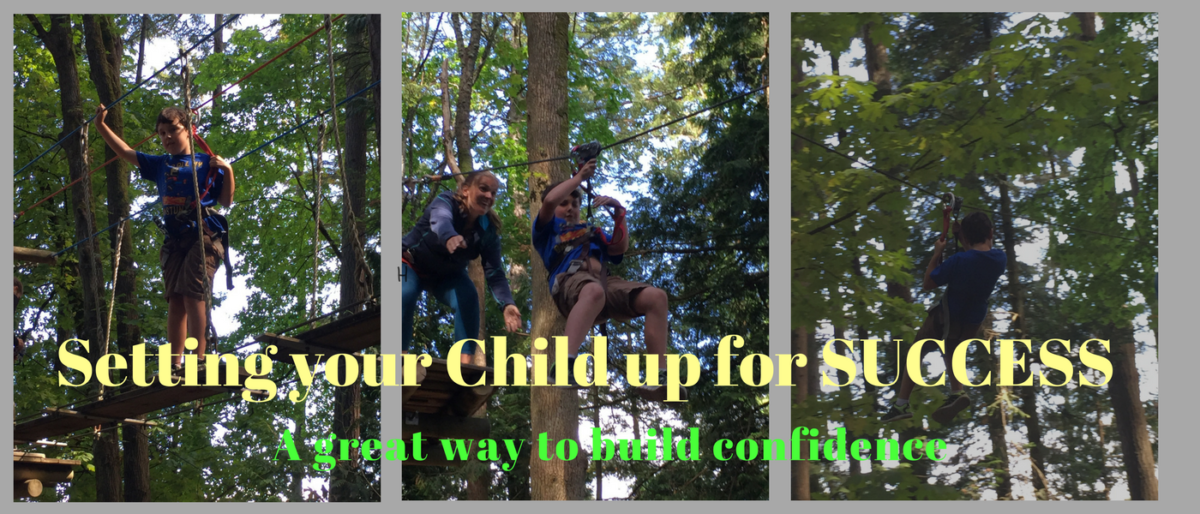
In the picture above we set my client up for success by having one of us at either side of the High Rope Obsticle to help him clip himself in and out of each saftey link along the way. We also prepared him for the feeling of the harness by having a practice one and by watching video’s of the course we were going on.

Teach the skills for Team Sports.

For example, kicking a ball for soccer, hit, catch, throw for baseball, or shoot, dribble, and pass for Basket ball.  It is also a good idea to teach the kids what the rules are and the different positions so that they don’t get too frustrated when things don’t go as they thought. I find if you don’t take the time to teach them the skills they need before joining the team, often they get frustrated that they can’t keep up with the rest of the team members.

Build their Public Speaking Skills

  • Ask them about their day or an activity

Ask questions that go into details.  For Example when I pick kids up from school in the car I like to start with, “can you tell me three things you did at school today?”  (Building memory skills and language) “What was the coolest thing that happened to you today? Why? How did it make you feel?” (so I am incorporating a variety of subjects and types of language) “What was the saddest or most frustrating thing that happened today? “(Building language around emotions, and maybe fit some social thinking strategies, or self regulation strategies) “Is there something you could do differently so that it wouldn’t be so frustrating/ sad? “

  • Play games

Games like I spy, guess who, what I am? That work on describing words. Have your child call out the bingo numbers/ letters / characters.  There are grocery shopping cart games where food vocabulary is incorporated and you can get almost any type of memory. Just make sure the children are labeling the pictures as they flip them over.

  • Have them ask other adults or peers questions.

Some examples of what I encourage the kids to ask are : “ Can I play?” Can you please help me ……..” “What are you doing?”

  • Have them tell stories

At bed time have them tell part of a story by looking at the pictures or have them make up a story.

Categories
Uncategorized

Top 9 Techniques On How To Instill Confidence In Your Child Who Is On the Autism Spectrum

One of the things I run across with my older clients (7 and up) is at some point they realize they are different than their classmates, and on some occasions, they either believe they can’t do it “because they have autism” or because they are dumb. Which you and I know, is not true. I like to remind them that everyone has strengths and weakness and we all can work to get better at them and the Autism is not an excuse. I like to encourage a growth mindset which basically says “I like the challenge, it means growth, failure is a learning opportunity, and I can always get better if I practice/work hard at it”

How do you instill a growth mindset in your children?


Let them fail, fail and fail again.

This teaches children perseverance, creates a good work ethic and builds hope to overcome struggles. Encourage them along the way, and point out the things that they did well and help them discover what they could do better.


Let them make mistakes

Help your kids develop a plan but let them carry it out, even if it isn’t perfect. Then look back at it, have the kids evaluate what they learned from it and make a new one.


Allow them learning experiences

Let the natural consequences of their actions play out , let them know it is okay to fail; it is okay not to be perfect. Also remind them of how their actions affect other people, “You choose to move slowly and missed the bus, so now I will be late to work because I have to drop you off at school”

Rather than giving children the answers allow them to trouble shoot when something doesn’t work out. Help them come up with a plan and let them carry it out and let them learn from what happened. Help them logically look at the situation.

  • How did you feel about….
  • What went well….
  • What didn’t go well……
  • What could you improve on……
  • What did you do wrong……
  • Another key thing to emphasize is the process or the journey and not just the end product.


Praise the accomplishment not their abilities

When you praise their abilities is saying to your child “you were born with these traits and we only like you because of those traits.” We are also telling them that “you can’t do anything about the things we are not good.”

When your praise their accomplishments by saying things like “I like how hard you practiced your spelling words this week so you could get a 100 %.” We are teaching them hard work pays off, determination, and that practice makes progress.


Be a role model of self-confidence

Your kids have eyes in the back of their heads too! I mean if you want your kids to have self-confidence you have to model it. Watch what you say to other adults because the kids are listening even if it doesn’t look like it. They hear you when you say “this is impossible, I am never going to understand why…… or my genetics are just like that”. Talk about your struggle, what you working on and celebrate when you accomplish something with your children. In your eyes you are super mom or dad you can just do everything, so let them know how long you had to practice before you could type at lightning speed, or before you got a good three point line shot.

Set them up for success

Give your children chores, make sure they are age appropriate (insert link), which allows them to grow a sense of responsibility. We can help instill this feeling of responsibility by saying things like “ I really like the way you …………….. so what is the plan for…………………..” or “ I would really like to take you to the park to see your friends but you have chores to do”

Front end loads them, give them the tools and skills they need to be successful. ie before starting base ball practice throwing, catching and hitting months before joining the team. Set realistic expectations; break things down into manageable parts, and remember they are still learning.

Giving children a confidence boost always helps too. We can do this by picking one of their biggest goals and creating opportunities for that to happen. For example, if your child wants money to buy some cool runners then have them do chores to raise the money they need.


Don‘t let them quit

Encourage perseverance and when they get really frustrated hint at a solution but don’t give it to them. Praise them when they do well, they need to hear it more than what they are doing wrong.


Give them choices whenever possible

It helps children develop a sense of identity, and self-worth, confidence, character, and independence. I give the children I work with choices all the time, usuallly they are all things on my agenda to be done but I let them choose what order we do them in, or what game it is we are going to play with a friend.


Help them to become confident speakers

Give them your undivided attention when they are speaking to you. Ask meaningful questions, and repeat back when you are not sure. Speak to them like you would another adult, they hear the change in tone or the change of language.

Some good ways to encourage confident speaking and language development are to ask about your surroundings, play games like eye spy, what am I? and guess who?.