Categories
Uncategorized

What to do with Picky Eaters?

Before I get into how one may help your picky eater become open to trying new things I want to look at 4 common mistakes parents make around feeding time.

  1. Parents interfere with eating, by using phrases like “two more bites”; eat this…. before that…., what is wrong with that you ask? Children are born with the natural ability to regulate food intake and know when they are hungry and when they are full. When you force them to eat more or less it teaches them to ignore what their bodies are telling them.
  2. Not having structured meal times, teaches a child to eat out of habit or boredom rather than hunger. It is important not to force a child to eat at set times but I encourage you to remind them, that the next meal time is X amount of hours a day.
  3. Cook a family meal that everyone eats. You are not a restaurant, and do not make special meals for your child. This encourages children to expand their taste buds, and their food repertoire. If your child is hungry enough they will try it.
  4. Pushing the veggies, many don’t know but 70% of young children have sensitivities to bitter compounds in vegetables that leave them uncomfortable, which will decrease over time.

Now we know what not to do here are 5 tricks to get your kids to try new foods

  1. Involve your children in the process of meal prep from shopping and prepping to cooking and serving. They will be more likely to try something they worked so hard to make.
  2. Make shopping a game, like bingo or eye spy in the grocery store with your child.

  3. Have them come shopping with you and discuss what the value each of the items have to their body. Carrots help with good eyesight; blue berries are full of antioxidants etc.
  4. Play with your food. You read that right, make meal time fun. Sing songs; make your broccoli dance on the plate maybe even on your tongue. Start with little things like holding the item, how does it feel? What does it smell like? Can you lick it? What does it taste like? Can you put it in your mouth and then spit it out? What did it feel like? Take one bite and spit it out, then 5, then chomp it all up and spit it out. Try one little bite, chew and swallow. Most likely won’t get through all the steps with the first try but if you continue exposing your child you will be surprised how they will come around.
  5. Have a child’s friend over to play with your child, preferably one that likes the food
    you’re exposing your child to. Peer pressure is sometimes a good thing.
    you’re exposing your child to. Peer pressure is sometimes a good thing.

I know what you are thinking this process could take awhile so what can I do in the mean time?

There are several things you could try. Hiding nutrients in the food they like; Protein or Greens powder in smoothies, applesauce, or yogurt as long as the color doesn’t turn the kids off. There is a million and one recipes online that hide carrots, zucchini, spinach in all kinds of food if you were so inclined to cook. You could also consider meal replacement drinks like Boost or Ensure, which tend to be chalking and not all that tasty. I have come across one meal replacement drink that is thin like juice and tastes like fruit juice without the sugar. For a couple of my client’s parent’s mix it with their child’s berry fruit juice in the mornings and the kids don’t even know it is there.
Categories
Uncategorized

Setting up your Child for Success

As I was driving home from work today it occurred to me there is so many ways to set your child up for success not only to build confidence but also it teaches them independence in many situations. Setting your child up for success can look different for every child; basically you want them to be able to accomplish their goal, no matter what that goal might be. Some goals will take more time than others but you can set them up for little successes along the way. As the parent it is your job to celebrate the little ones on the way so that they realize them for what they are…. accomplishments.

Making sure your children are getting enough sleep, physical activity, and good nutrition is a good place to start. It is the hundreds of little successes that are going to build your Child’s confidence so they can tackle the bigger ones later.

Activities of Daily Living that can Build Confidence

  • Encourage them to dress themselves. The night before help the logically pick out some clothes by reminding them of things like weather, season, and activities for the next day. I know from experience that if I let the 5 year old girl dress herself, she is likely to choose her favorite dress, ankle socks, and shiny shoes, on a day when they are going on a farm tour. I don’t mean make their clothes match, if they want an orange shirt and pink pants so be it. In my experience it is good to make sure the kids are picking out clothes they can do themselves, so watch out for buttons or zippers if that is something your child struggles with.
  • Let them make their breakfast, and lunch for school. Make this easy by have the utensils, bowl, cereal, or the jam, peanut butter, bread and toaster in a place that is accessible to them. I also found leaving a small pitcher or a cup of milk in the fridge works better then letting them pour from a milk jug.

Artistic Pursuits that Build Confidence

  • Put your child’s art up, maybe even frame it. It doesn’t matter if you know what it is or if the horse is purple, green and orange. It shows you are proud of them.
  • Find homemade gifts for the children to make for family members and friends. Be positive and resist the urge to change their work because it sends a message that their job is not good enough. Like mentioned in previous blogs we want to congratulate the effort and the process not the accomplishment.
  • Show off the video or pictures of their first recital, show, or number.
  • Let them tell you about their art and really listen and ask good questions about their art like; what is it made of?, how long did it take to make?, what part was the most fun to do?

Outdoor Activities and Sports that build confidence

Take your kids to the park

Let your children climb, swing, and slide. I usually try and encourage them to do it on their own, if they can’t climb up by themselves then their bodies aren’t big enough yet. I do, however, give them hints to how to do the task. Teach them to ride a bike, skip, roll down a hill, or play a new playground game.  As they master those skills they will build confidence in their body’s ability to learn new things.

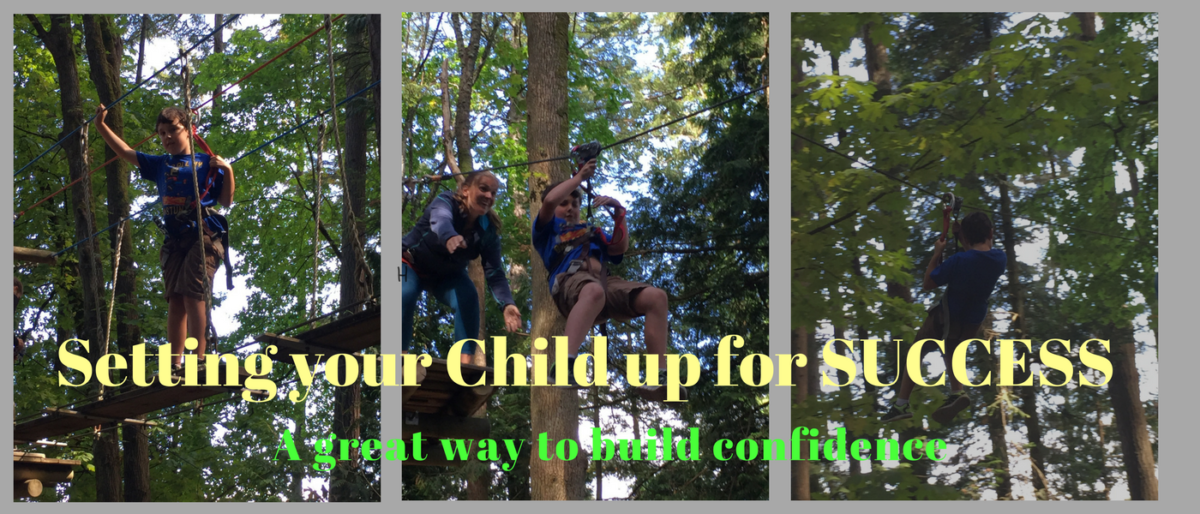
In the picture above we set my client up for success by having one of us at either side of the High Rope Obsticle to help him clip himself in and out of each saftey link along the way. We also prepared him for the feeling of the harness by having a practice one and by watching video’s of the course we were going on.

Teach the skills for Team Sports.

For example, kicking a ball for soccer, hit, catch, throw for baseball, or shoot, dribble, and pass for Basket ball.  It is also a good idea to teach the kids what the rules are and the different positions so that they don’t get too frustrated when things don’t go as they thought. I find if you don’t take the time to teach them the skills they need before joining the team, often they get frustrated that they can’t keep up with the rest of the team members.

Build their Public Speaking Skills

  • Ask them about their day or an activity

Ask questions that go into details.  For Example when I pick kids up from school in the car I like to start with, “can you tell me three things you did at school today?”  (Building memory skills and language) “What was the coolest thing that happened to you today? Why? How did it make you feel?” (so I am incorporating a variety of subjects and types of language) “What was the saddest or most frustrating thing that happened today? “(Building language around emotions, and maybe fit some social thinking strategies, or self regulation strategies) “Is there something you could do differently so that it wouldn’t be so frustrating/ sad? “

  • Play games

Games like I spy, guess who, what I am? That work on describing words. Have your child call out the bingo numbers/ letters / characters.  There are grocery shopping cart games where food vocabulary is incorporated and you can get almost any type of memory. Just make sure the children are labeling the pictures as they flip them over.

  • Have them ask other adults or peers questions.

Some examples of what I encourage the kids to ask are : “ Can I play?” Can you please help me ……..” “What are you doing?”

  • Have them tell stories

At bed time have them tell part of a story by looking at the pictures or have them make up a story.